
I will be the first to hear welcome criticism
Dorothy Luke records the following quote from Parkhurst: “I will be the first to hear welcome criticism” (Luke, n.d.). Parkhurst calls on teachers to experiment with her Dalton Plan. “I do not claim that my plan is perfect. Many people need to focus on it and work on it together if it is to be a living and vital thing (…)” (Parkhurst quoted in Wilson, 1926, pp. 23-24). Lynch, the headmaster of the Westgreen School—one of the first Dalton schools in England—also talks about Parkhurst’s intentions in this regard: “She wanted the Plan to be a growing thing; and she wanted researchers other than herself to contribute to its growth” (Lynch, 1924, p. 8). There is therefore no such thing as ‘the’ orthodox form of Dalton education. Dalton education is flexible. Teachers must tailor the education they wish to provide according to the basic principles of Parkhurst’s Dalton Plan to the place and time in which they live, the circumstances of the moment, and the population of children with whom they work. This requires not only the school as a whole, but also individual teachers to develop their own vision of Dalton education. Every teacher must be able to answer the question of where in their teaching practice it can be seen that they are working to realize their Dalton vision.
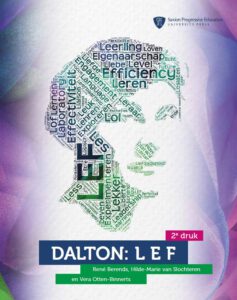
The first article in this section provides guidance on developing your own vision of Dalton education. It is a chapter translated into English from the Dutch-language training book by Berends, Otten-Binnerts, & van Slochteren (2022). Dalton LEF: PO.
How to develop an educational vision on the Dalton Plan
Broad personal Development
In Dalton education, the child is central, but the development of each individual cannot be viewed separately from the group in which this individual develops and cannot be viewed separately from the world of which he or she is a part. Dalton education does not promote forms of individualism. It is about shaping the child as a person, and in doing so, teachers must be attentive to the development of the child’s own talents and interests, but also teach the child to relate to themselves, others, and other things. They need others and other things in order to develop as a person. Three educational philosophers discussed this process of forming oneself as a person. In this article, René Berends reports on their findings and translates their insights in such a way that they can be applied in Dalton education.
Person formation as a solemn task for Dalton education