Dalton worldwide
Nowadays, shaping Dalton education seems to be primarily a Dutch issue. There are around 400 Dalton schools in this country, attended by more than 100,000 children. One in twenty primary and secondary schools in the Netherlands are Dalton schools.
Worldwide, there are currently around 200 other Dalton schools, but this was not the case before the Second World War. At that time, there were several thousand Dalton schools in Great Britain and Japan and many hundreds of Dalton schools in the United States, China, and the USSR. But during the crisis of the 1930s and in the run-up to World War II, the global hype surrounding progressive education came to an end. With the exception of a few prominent private schools such as the New York Dalton School and the Ascham School in Sydney, only the Netherlands retained a substantial number of Dalton schools. The reason for this? In the Netherlands, freedom of education is enshrined in the constitution.
The Utrecht-Brno city partnership as the starting point for a Dalton revival
After the fall of the Berlin Wall in 1989, the former Eastern Bloc countries turned their attention to the West. Old relationships were revived and new ones were formed. This involved not only business connections, but also cooperation in the cultural and educational fields.
In the 1990s, the city of Utrecht in the Netherlands entered into a city partnership with Brno in the Czech Republic. Representatives from both cities visited each other and sought areas in which cooperation could take concrete form.
During the preparations for one of the visits to Brno, the Utrecht municipal education inspector was injured. A replacement was urgently sought. This was found in the person of Roel Röhner, then director of the Pieterskerkhof Dalton school, the oldest Dalton primary school still in existence in the Netherlands. Roel had previously indicated to the municipality of Utrecht that he was open to establishing contacts with foreign teachers and schools in the field of education.
His lecture on educational developments in the Netherlands was well received. Contacts were expanded. Teachers from Brno were introduced to the Dalton concept and visited Dalton schools in the Netherlands.
Building an international Dalton organization
Brno and Utrecht became centers from which new partnerships in the Dalton field emerged. Interested parties from various former Eastern European countries attended the conferences in Brno, which led to the establishment of Dalton schools in Hungary, Slovakia, Poland, and former East Germany, among other countries. In Austria, Poland, and Slovakia, this also led to the establishment of their own national Dalton associations.
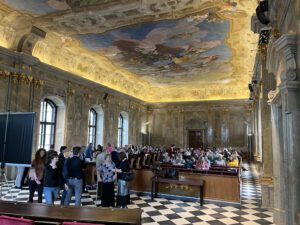 [Conference about Dalton education, Brno 2021]
There are also countries where the focus is not yet on establishing their own autonomous associations. Instead, there is talk of establishing a ‘Department’ of Dalton International. This applies, for example, to Turkey and China. This offers the advantage that no autonomous association needs to be run and that expert support for the schools is provided by Dalton International.
There are also countries and regions where Dalton has developed independently, without any connection to Dalton International. For example, there are Dalton schools in the former West Germany and several Dalton schools in the Flemish-speaking part of Belgium, which are in contact with each other but develop without any input from or contact with Dalton International.
There are also countries where a single school or just a few schools present themselves as Dalton schools and have joined Dalton International.
And finally, there are of course the two leading schools in New York and Sydney. Dalton International representatives are now working closely with both schools.